
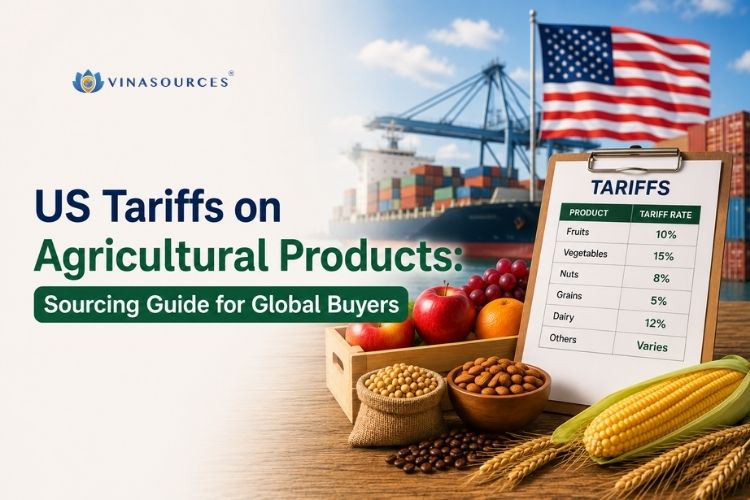
Buying agricultural products for the US market can be very profitable, but hidden import taxes can quickly ruin your budget. To protect your profits, you must understand US agricultural tariffs.
This complete sourcing guide will show you how these taxes work, how to check your product rates, and how to reduce your trade costs easily.
Key Factors That Determine US Agricultural Tariff Rates
US Customs and Border Protection (CBP) does not use a single tax rate for all food and agricultural imports. Instead, your final import duty depends on five core regulatory and market factors.
1. Product Processing Level
- Raw & Bulk Commodities: Unprocessed agricultural goods (such as green coffee beans, raw cashew nuts, or whole pepper) usually enter the US at a 0% tariff rate.
- Value-Added & Processed Goods: If you import roasted coffee, salted cashews, or retail-packaged snacks, the tariff rate increases. The duty often switches to a percentage-based tax (ad valorem) between 5% and 13.1% because you are importing a finished consumer product.
2. Country of Origin
The US Harmonized Tariff Schedule (HTS) splits all global trading partners into different tax categories based on international political relationships:
- Normal Trade Relations: Most countries, including Vietnam, maintain friendly economic ties with the US. They receive standard, low baseline tariff rates.
- Free Trade Agreements: Nations with direct free trade deals with the US (like Canada and Mexico under the USMCA agreement) can import agricultural goods duty-free (0% tax), provided they meet strict rules of origin.
- Non-Normal Trade Relations: Countries without friendly trade status with the US (such as Cuba, North Korea, Russia, and Belarus) face very high penalty tax rates, often reaching 30% to 50% for agricultural goods.
3. Seasonal Import Windows and Quotas
To safeguard American farmers during local harvest seasons, the US utilizes Tariff-Rate Quotas (TRQs) and flexible seasonal tariffs.
- In-Season Surcharges: During peak harvest months for US farms, tariffs on specific fresh fruits and vegetables increase sharply to block cheap foreign competition.
- Off-Season Windows: When US farms cannot produce enough, the US government lowers tariffs or opens duty-free volume quotas to satisfy consumer demand.
4. Trade Defense Actions (Anti-Dumping and Section Surcharges)
The Office of the US Trade Representative (USTR) frequently updates special economic penalties to protect the US market from unfair foreign pricing:
- Anti-Dumping (AD) Duties: If an overseas supplier sells agricultural products below fair market value, the US adds an extra percentage penalty of up to 50%-100%.
- Section 301 Surcharges: The US places broad tariff penalties on nations with massive trade imbalances (such as China), which can add an extra 7.5% to 25% tax on top of the standard agricultural duty.
5. Packaging Form (Bulk vs. Retail-Ready)
US tariff policies favor domestic packaging factories. Therefore, how your cargo is packed at the port changes its final HTS classification.
- Bulk Industrial Bags: Shipping agricultural goods in large bulk containers (such as 50 kg jute bags) usually yields a 0% baseline tariff.
- Retail-Ready Pouches: Packing the exact same product into small, labeled retail jars or pouches ready for grocery shelves often triggers stricter FDA inspections, complex labeling laws, and higher Customs User Fees.
US Tariffs on Agricultural Products by Country
The table below outlines the top agricultural exporters to the US and their effective tariff rates
| # | Country | Effective Tariff Treatment & Special Surcharges |
| 1 | Vietnam | 10% to 20% Effective Bracket. Critical raw materials (raw coffee/whole pepper) remain highly cost-competitive with zero penalty risks. |
| 2 | Canada | 0% (Duty-Free) for USMCA-compliant goods. (Strict volume-based quotas apply to grain and dairy). |
| 3 | European Union | 10% to 15% Effective Duty. Processed consumer foods face specific ad valorem adjustments. |
| 4 | Brazil | 10% Baseline Tariff. Subject to an additional 40% reciprocal safety duty margin on specific fresh meats. |
| 5 | Chile | 0% (Duty-Free) via the US-Chile Free Trade Agreement for qualified fresh produce categories. |
| 6 | Colombia | 0% (Duty-Free) via the US-Colombia Trade Promotion Agreement. |
| 7 | Indonesia | 10% to 19% Effective Duty. Subject to rigid agricultural sanitation and quality checks. |
| 8 | Mexico | 0% (Duty-Free) for USMCA-compliant goods. (Non-compliant agricultural goods face a 10% baseline surcharge). |
| 9 | India | 10% to 25% Defensive Duty. High-risk origin is subject to strict anti-dumping investigations and trade caps. |
| 10 | China | High-Risk (10% to 84%+). Faces standard baseline rates PLUS heavy Section 301 trade penalties on processed foods. |
Standard US Tariff Rates for Common Agricultural Imports
Below is a quick reference table for the most popular agricultural products imported into the US, especially from Southeast Asian hubs like Vietnam:
| Product Category | Common HTS Code | Baseline US Tariff Rate |
| Green Coffee Beans | 0901.11.00 | 0% (Free) |
| Roasted Coffee Beans | 0901.21.00 | 0% (Free) |
| Roasted/Salted Cashews | 2008.19.10 | 11.2% – 13.1% |
| Black/White Pepper | 0904.11.00 | 0% (Free) |
| Crushed/Ground Pepper | 0904.12.00 | 0% (Free) |
| Fresh Tropical Fruits | 0810.90.46 | 0% – 2.2% (Requires USDA import permit) |
Why Do US Buyers Source Agricultural Products from Vietnam?
Vietnam has become a powerful global leader in agriculture. For international businesses, especially those in the United States, importing from Vietnam offers major strategic advantages.
Here are five practical reasons why Vietnam is an excellent sourcing partner:
1. Top Global Exporter of Key Commodities
Thanks to its favorable tropical climate, fertile river delta systems such as the Mekong Delta and Red River Delta, and nutrient-rich volcanic soil in the Central Highlands, Vietnam has developed into one of the world’s leading agricultural exporting countries. By the end of 2025, the country’s total agricultural, forestry, and fishery export turnover reached a record $70.09 billion.
- Core Products: Vietnam is the world’s second-largest exporter of coffee (earning a record $8.57 billion in 2025) and a top global supplier of rice, cashews, and black pepper.
- Tropical Fruits: The country exports high-value fruits like durian (which reached $4 billion in export value), dragon fruit, and mangoes. This massive production scale ensures that international buyers can find high-quality products at competitive prices.
2. Full Compliance with International Standards and Certifications
Vietnamese exporters deeply understand international food regulations. To enter strict markets like the US, companies have upgraded their production lines to meet global requirements.
- Certifications: Most large-scale farms and processing facilities hold certifications such as GlobalGAP, ISO, HACCP, and BAP (Best Aquaculture Practices).
- USDA and FDA Compliance: Major Vietnamese packing houses and processing facilities utilize state-of-the-art irradiation, hot water treatment (HWT), and quick-freezing technologies that comply directly with USDA Animal and Plant Health Inspection Service (APHIS) and FDA food safety regulations.
3. Stable and Large-Scale Supply Chains
Vietnam utilizes over 124,000 square kilometers of dedicated agricultural land, which allows for large-scale, continuous cultivation across diverse climate zones. This extensive land area drives massive annual production volumes, such as reaching a record-high rice output of 43.5 million tons in 2025.
4. Strong Diplomatic Foundation
The upgraded Vietnam – US Comprehensive Strategic Partnership acts as a powerful legal and political shield for international supply chains.
The US government maintains a baseline 20% reciprocal tariff on the majority of Vietnamese-originating goods. This rate represents a significant reduction from the previous 46% penalty tier, providing a much more stable environment for B2B price calculations.
Both nations are actively negotiating the official Framework for an Agreement on Reciprocal, Fair, and Balanced Trade. This ongoing diplomatic effort focuses on harmonizing bilateral interests, expanding market access, and facilitating digital trade, services, and cross-border investments.
Connect with verified Vietnamese Agricultural Suppliers?
If you are looking to import high-quality agricultural products from Vietnam into the US market, finding a trustworthy partner is the most important step.
VinaSources serves as your reliable bridge to connect directly with pre-verified Vietnamese manufacturers and agricultural cooperatives.
- 100% Pre-Verified Manufacturers: We strictly check every supplier’s background, active business licenses, and real production capacity before listing them on our marketplace.
- Direct Factory-Direct Pricing: By bypassing expensive trading middlemen, VinaSources connects you directly to farm processors, protecting your profit margins and lowering your final landed cost.
- Streamlined RFQ Process: You can easily send a Request for Quote (RFQ) detailing your volume requirements, packaging forms, and destination port. Our system matches you with the best available suppliers.
Fill out the RFQ on our platform today, call our direct support line at 1900 4356, or email us at [email protected] to get instant, verified quotes from Vietnam’s leading agricultural exporters.